
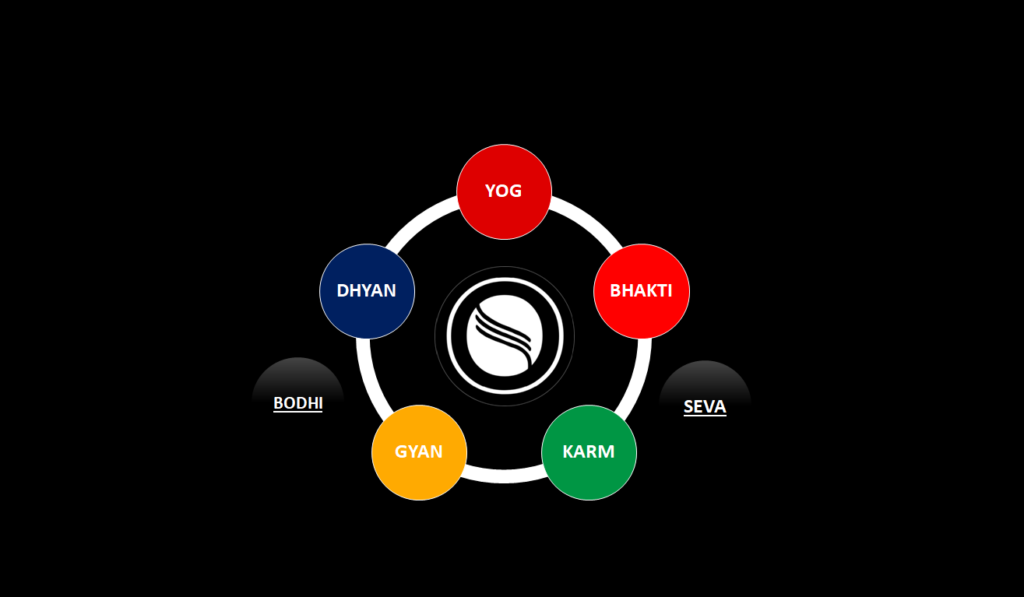
The ultimate goal of human life is a deep philosophical question, and different traditions, cultures, and individuals answer it differently. But here’s a grounded and widely resonant perspective:
To live meaningfully — with purpose, connection, growth and freedom.
This can break down into a few core ideas:
1. Absolute Freedom
Freedom in each and every aspect of life, Physical, Mental and Spiritual.
- Moksha (liberation & Salvation)
- Nirvana or Enlightenment.
- Jivanmukta
2. Purpose
Doing something that feels worthwhile. That could be:
- Creating something valuable
- Contributing to others’ lives
- Solving problems
- Expressing your talents
- A life without purpose often feels empty, no matter how successful it looks.
3. Connection
We are social beings. Meaning comes through:
- Deep relationships
- Love and compassion
- A sense of belonging
Even great accomplishments can feel hollow if we’re isolated.
4. Growth
To evolve mentally, emotionally, spiritually.
- Learning
- Reflecting
- Improving character
Growth makes life feel dynamic instead of stagnant.
5. Inner Freedom
Ultimately, every pursuit — wealth, love, success — aims at one thing: peace or fulfillment.
- Knowing who you are
- Making peace with your past and uncertainties
- Letting go of ego and fear
This is emphasized in spiritual traditions like Vedanta, Buddhism, Stoicism, and more.
———————————————————————————————————————————————————————
Now, let’s explore how different philosophies define the ultimate goal of human life. Each offers a unique lens:
1.The Bhagavad Gita (Vedantic/Hindu Philosophy)
Ultimate Goal: Self-realization — realizing the Atman (true self) and its unity with Brahman (universal consciousness).
Key Teachings:
- Do your duty (dharma) without attachment to results (karma yoga).
- Control desires and ego through discipline and devotion.
- Detach from outcomes — seek equanimity.
- Attain moksha (liberation) by knowing the self beyond the body and mind.
“You have the right to work, but not to the fruits of your work.” – Bhagavad Gita 2.47
Goal: Liberation (moksha), inner freedom from ego and illusion
2.Buddhism
Ultimate Goal: End of suffering (Nirvana) — liberation from the cycle of birth and death (samsara).
Key Teachings:
- Life involves suffering due to craving and attachment.
- Follow the Eightfold Path: right view, intention, speech, action, livelihood, effort, mindfulness, and concentration.
- Cultivate compassion, mindfulness, and wisdom.
- Let go of the illusion of a permanent “self.”
“Peace comes from within. Do not seek it without.” – Buddha
Goal: Awakening to the impermanence of all things and letting go.
3.Stoicism (Ancient Greek Philosophy)
Ultimate Goal: Live in agreement with nature, using reason and virtue.
Key Teachings:
- You can’t control external events, only your thoughts and actions.
- Practice virtue: wisdom, courage, justice, temperance.
- Accept fate (amor fati) and maintain inner tranquility.
- Don’t be a slave to desire or fear.
“The happiness of your life depends upon the quality of your thoughts.” – Marcus Aurelius
Goal: Inner peace through reason, self-control, and acceptance of life’s flow.
4. Existentialism (Modern Western Philosophy)
Ultimate Goal: Create your own meaning in a universe that doesn’t give it to you.
Key Teachings:
- Life has no pre-given meaning; it’s your responsibility to give it one.
- Embrace freedom and the anxiety that comes with it.
- Live authentically, aligned with your values, not society’s pressures.
- Death is inevitable — so live fully now.
“Man is nothing else but what he makes of himself.” – Jean-Paul Sartre
Goal: Authenticity and responsibility in shaping your life.
5. Modern Positive Psychology (Science-based)
Ultimate Goal: Flourishing — not just happiness, but fulfillment.
Key Pillars (PERMA Model):
- Positive emotion
- Engagement (flow)
- Relationships
- Meaning
- Accomplishment
“A meaningful life connects us to something bigger than ourselves.” – Martin Seligman
Goal: Balanced, meaningful well-being.
——————————————————————————————————————————————————————
CORE PRINCIPLES TO FOLLOW DAILY TO ACHIEVE THESE GOALS:
1. Meditation, Self-Inquiry & Awareness (Jnana Yoga / Mindfulness / Reflection)
Meditate and attain Samadhi (Samprajnat and Asamprajnat)
“Who am I?” — This is the heart of liberation.
How to practice:
- Observe your thoughts as a witness, not the thinker.
- Ask: “Am I this thought/emotion/body?”
- Reflect: “What remains when everything else changes?”
Tools:
- 15–30 mins of silent meditation daily.
- Journaling your thoughts, triggers, and insights.
- Read: Patanjali Yoga Sutra, Bhagwad Gita, Ashtavakra Gita, Vivekachudamani, or Ramana Maharshi’s works.
2. Detachment from Results (Karma Yoga / Stoicism)
“You are not the doer, nor the owner of the results.”
How to practice:
- Focus on action, not outcome.
- Be equally calm in success and failure.
- Say: “Let me give my best, and leave the rest to the higher will.”
Daily mantras:
- “This too shall pass.”
- “I’m only responsible for my effort.”
3. Mindfulness & Compassion (Buddhism)
Be present. Let go of craving and aversion.
How to practice:
- Throughout the day, pause and observe your breath, body, and reactions.
- Speak and act mindfully, not reactively.
- Practice compassion toward others — everyone suffers in some form.
Techniques:
- 5-min mindful breathing sessions.
- Loving-kindness meditation (Metta).
- Mindful walking, eating, or speaking.
4. Control of Desires and Senses (Yogic Restraint / Stoic Simplicity)
“Freedom comes when you stop chasing and start observing.”
How to practice:
- Avoid overstimulation: digital detox, simple food, minimalism.
- Delay gratification: say “no” to urges sometimes — train willpower.
- Examine the root of your cravings — what are you really seeking?
Tip:
- Fasting (mental or physical) once a week is a powerful method.
5. Seva (Service) & Bhakti (Devotion)
Purify the ego by serving without expecting anything.
How to practice:
- Help others without expecting return.
- Dedicate actions to a higher power or principle (Ishwara Pranidhana).
- Cultivate gratitude: “Everything I have is a gift.”
Simple practice:
5 mins of chanting, prayer, or gratitude journaling.
6. Study of Scriptures (Svadhyaya)
Read wisdom literature — not just for knowledge, but transformation.
Examples:
- Patanjali Yoga Sutra
- Bhagavad Gita
- Dhammapada (Buddha’s sayings)
- Yoga Vasistha
- Meditations – Marcus Aurelius
- Upanishads
Practice:
- Read 1 shloka or verse daily and reflect deeply.
- Join a satsang (spiritual community) or discussion group.
7. Silence and Solitude (Mauna & Vairagya)
Space is needed for the truth to echo within.
How to practice:
- Daily quiet time — 10–30 minutes unplugged.
- Periodic retreats or solo time.
- Observe mauna (noble silence) for 1 hour per week.